

Pervaziv AI Introduces Cortex Verify, Bringing AI Patch Validation to Its Seven-Model AI Ensemble

New model helps engineering teams connect requirements, code, organizational standards, tests, and validation evidence before AI assisted work moves forward.
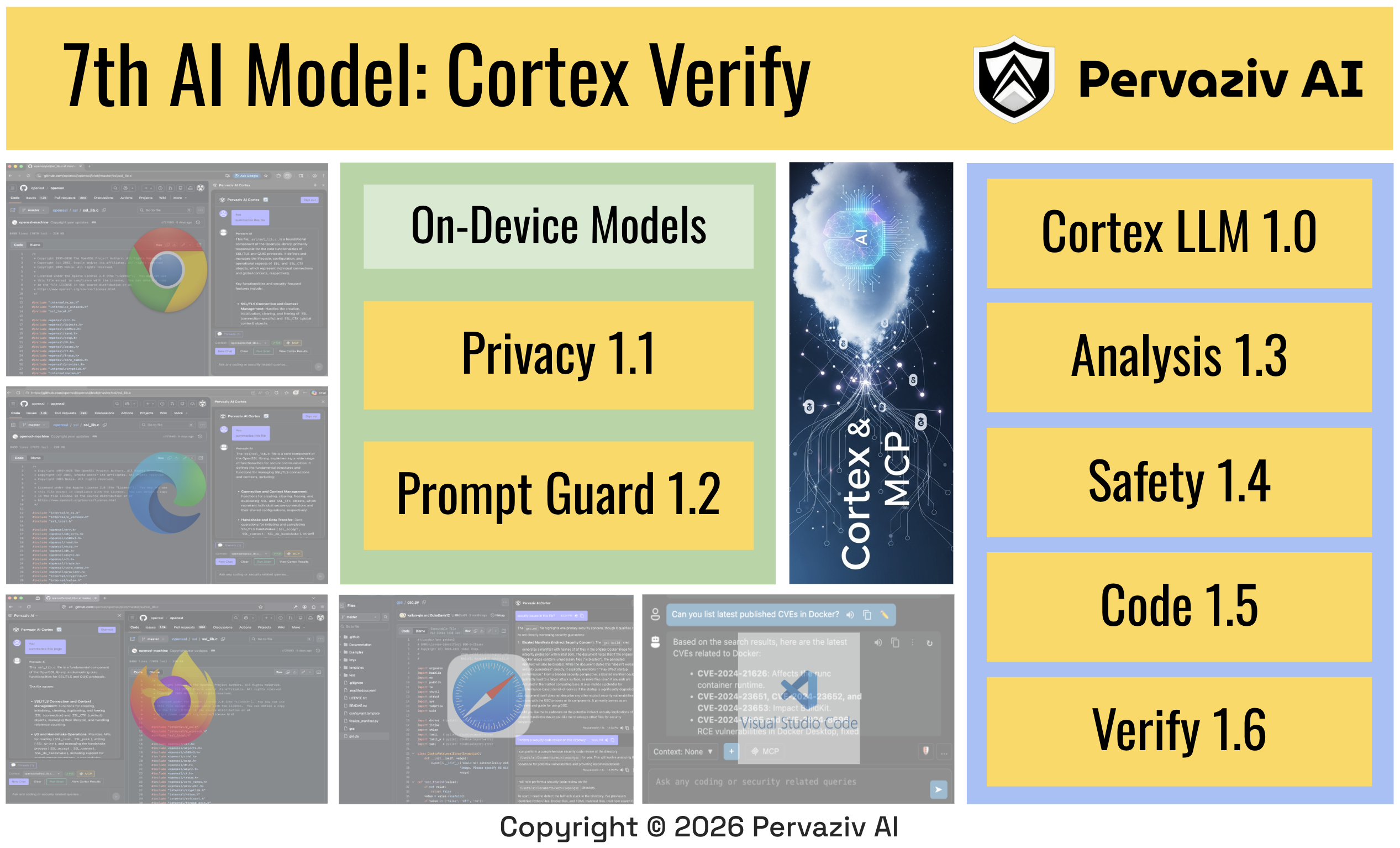
SAN FRANCISCO, CA, UNITED STATES, August 4, 2026 /EINPresswire.com/ -- Pervaziv AI today announced Cortex Verify 1.6, the seventh specialized model in the Cortex AI Model Ensemble. The new model adds focused patch validation and evidence based reasoning to Cortex, helping engineering teams evaluate whether proposed software changes address intended requirements, follow organizational standards, preserve expected behavior, and include sufficient validation before they are merged or deployed.
Cortex Verify builds on the six model ensemble introduced with Cortex 5.2. That architecture established a coordinated family of specialized AI models for secure development workflows, privacy awareness, prompt risk protection, security analysis, safety aware decisions, and broad coding assistance.
With Cortex Verify, the ensemble now adds a dedicated capability for evaluating whether an AI generated or human assisted change is supported by the context, testing, and evidence required for the next engineering decision.
“AI can generate a patch in seconds, but enterprise teams still need to know whether it is the right patch, whether it addresses the complete requirement, and whether the evidence is strong enough for the next decision,” said Anoop Jaishankar, Founder and CEO of Pervaziv AI. “Cortex Verify adds that missing validation layer. It helps move AI assisted development from plausible output toward supported engineering decisions, while keeping accountability with developers, reviewers, and the organizations responsible for the software.”
## Bringing Clearer Validation to AI Assisted Software Delivery
----------------------------------------------------------------------------------
AI assisted development is changing how organizations build software. Teams can move from an idea or reported issue to a proposed implementation faster than ever, with AI helping explain code, investigate defects, generate changes, recommend improvements, and create tests.
But faster output does not automatically produce more dependable software.
A patch can appear technically reasonable while missing an acceptance condition. It can resolve a visible symptom without addressing the underlying behavior. It can pass a narrow test while failing in an important user workflow. It can also be functionally correct but inconsistent with the architecture, coding conventions, quality requirements, or risk posture of the organization.
For enterprise teams, the question is therefore not simply whether AI can generate a patch. It is whether the proposed change is aligned with the intended outcome, supported by meaningful evidence, and ready for the appropriate level of review.
Cortex Verify is designed to help address that question.
The model examines the relationship between a proposed change, the task it is intended to solve, the available engineering context, and the validation evidence surrounding it. Its role is not to automatically approve or reject software changes. Its role is to help teams understand what supports a change, what remains uncertain, and what additional validation may be required.
## The Seventh Model in a Specialized AI Ensemble
---------------------------------------------------------------------
Cortex 5.2 introduced the Cortex AI Model Ensemble as a modular architecture in which distinct models support different responsibilities across secure software development.
The seven model ensemble now includes:
• Cortex LLM 1.0 for structured secure development workflows
• Cortex Privacy 1.1 for sensitive data awareness near the developer
• Cortex Prompt Guard 1.2 for prompt injection and instruction risk classification
• Cortex Analysis 1.3 for deeper security analysis and structured findings
• Cortex Safety 1.4 for safety aware workflow decisions
• Cortex Code 1.5 for broad coding assistance
• Cortex Verify 1.6 for patch and validation reasoning
Each model has a focused role. Together, they help Cortex apply the appropriate type of intelligence at different points in the software development lifecycle.
Instead of asking one general purpose model to generate code, protect sensitive information, detect prompt risks, analyze vulnerabilities, make safety decisions, and verify its own output, Cortex distributes those responsibilities across specialized capabilities.
Cortex Verify completes an important part of that cycle by focusing on what happens after a change has been proposed. It introduces a central question into the workflow: What evidence supports this change?
That question helps teams determine whether a patch addresses the intended behavior, whether testing reflects the actual risk, and whether the available evidence is sufficient for the next decision.
## From Generated Output to Supported Engineering Decisions
-------------------------------------------------------------------------------------
Early AI coding workflows focused primarily on generation. Models helped teams write code, explain repositories, summarize functions, troubleshoot errors, and draft tests.
These capabilities remain valuable, but enterprise software delivery requires a more connected process. Teams must also reason about intent, implementation, architecture, maintainability, security, test quality, and operational readiness.
Cortex Verify helps bring these considerations together.
When an AI system or developer proposes a patch, Cortex Verify can help assess questions such as:
• Does the change address the requested product or technical outcome?
• Does it satisfy the complete requirement and acceptance criteria?
• Does it preserve behavior that should remain unchanged?
• Is it consistent with the architecture and engineering conventions of the organization?
• Are the proposed tests connected to observable outcomes?
• Does the validation reflect the level of risk involved?
• Is important context missing from the task or implementation?
• Does the change require additional testing, security analysis, safeguards, or human review?
The model is intended to make these questions more visible and repeatable within AI assisted workflows.
Cortex Verify does not focus only on syntax or whether code compiles. A change can be syntactically valid and still be incomplete, poorly tested, architecturally inconsistent, or unsafe in a broader system context.
By examining the relationship between intent, implementation, and evidence, Cortex Verify helps teams move beyond whether a patch merely looks plausible.
## Evaluating Requirements, Behavior, and Engineering Context
--------------------------------------------------------------------------------------
One of the central challenges in AI assisted development is that generated code may appear correct in isolation while failing to account for wider system behavior.
A proposed change may modify the expected function but overlook a dependent service, data contract, authorization boundary, integration, or failure condition. It may implement the most visible part of a requirement while leaving secondary acceptance criteria unresolved.
Cortex Verify is designed to help identify these gaps.
The model can examine whether the proposed implementation corresponds to the stated task and whether important conditions remain unaddressed. It can also help evaluate whether expected behavior is preserved, especially when a small modification may affect other components or workflows.
This becomes particularly important in complex applications, distributed systems, cloud services, security sensitive functions, and enterprise integrations where local correctness does not always imply system level correctness.
Cortex Verify can also consider whether a change aligns with established engineering practices. This includes coding patterns, architectural constraints, maintainability expectations, and other contextual standards defined by the organization.
The goal is to help prevent AI generated work from drifting away from the long term structure and quality expectations of the codebase, even when the immediate patch appears functional.
## Stronger Test and Evidence Evaluation
--------------------------------------------------------
A generated test is not automatically meaningful proof that a requirement has been satisfied.
Tests can be too narrow, overly connected to implementation details, or limited to the expected success path. They may confirm that a function returns a value without examining authorization, persistence, error handling, compatibility, concurrency, integration behavior, or other important conditions.
Cortex Verify evaluates whether the available tests and supporting evidence are appropriate for the proposed change.
The model can help examine whether tests validate the intended behavior, whether relevant edge conditions or failure paths are covered, and whether the validation effort reflects the risk level of the change.
It can also identify when evidence is weak, incomplete, or disconnected from the requirement.
When additional support is needed, Cortex Verify can surface the need for stronger tests, more system context, further security analysis, additional safeguards, or review by an appropriate human decision maker.
In this way, Cortex Verify acts as a decision support capability rather than an automated gatekeeper.
## Connecting Personal Coding Style and Test Design Specification
------------------------------------------------------------------------------------------
Cortex Verify is designed to work alongside Personal Coding Style and Test Design Specification, creating a more structured framework for responsible AI assisted development.
Personal Coding Style helps Cortex reflect the conventions and preferences that make a team’s codebase consistent and maintainable. It recognizes that a technically valid change can still create friction if it does not fit established approaches to naming, structure, documentation, error handling, modularity, or testing.
Test Design Specification addresses a related challenge. It helps define the behavior that matters, the risk boundaries involved, and the evidence required to demonstrate that a requirement has been met.
Cortex Verify connects these capabilities when a proposed change must be evaluated.
Personal Coding Style helps define how work should fit the organization. Test Design Specification helps establish what should be proven. Cortex Verify helps determine whether the implementation and available evidence satisfy those expectations.
Together, they can help teams evaluate a patch against:
• The intended business, product, security, or technical outcome
• The coding and architectural conventions of the organization
• The behavior that must be preserved
• The risks introduced or affected by the change
• The tests and other evidence supporting the implementation
• The remaining uncertainty or missing context
• The level of review appropriate for the task
This creates a clearer progression from requirement to implementation to validation.
## Supporting Human Judgment, Not Replacing It
--------------------------------------------------------------------
Cortex Verify is designed to support developers and reviewers rather than replace them.
Software engineering remains a discipline of context and tradeoffs. Human teams understand architectural history, product requirements, customer impact, operational realities, and business priorities that may not be fully represented in a single prompt, issue, or code change.
Human judgment is particularly important when changes affect sensitive data, identity and access controls, financial operations, customer facing behavior, regulated processes, production infrastructure, or critical integrations.
Cortex Verify can help make review more focused by surfacing assumptions, validation gaps, and areas requiring deeper attention.
Instead of spending the entire review determining whether a generated patch is superficially plausible, teams can focus on whether the approach is appropriate, whether evidence is sufficient, and whether unresolved risks remain.
The people and organizations responsible for the software retain control over final decisions.
## Validation Across the Development Lifecycle
----------------------------------------------------------------
Cortex Verify can support multiple stages of AI assisted software delivery.
During implementation, it can help developers determine whether a proposed fix addresses the complete requirement.
During testing, it can help assess whether validation is tied to the behavior the organization needs to protect.
During security remediation, it can help connect a patch with the vulnerability, affected boundary, and evidence required to demonstrate that risk has been reduced.
During code review, it can help reviewers concentrate on design, security, maintainability, and business impact.
During delivery, it can help create a clearer record of why a change is believed to be ready and what limitations or follow up actions remain.
Cortex Verify is intended to complement deterministic testing, continuous integration, static analysis, security scanning, policy enforcement, code ownership, approval rules, runtime validation, and human review.
Model based reasoning does not replace these controls. It helps connect their results to the software change and the requirement being evaluated.
## Supporting Confidence Across the Enterprise
-----------------------------------------------------------------
For engineering leaders, verification is not only a technical concern. It is also an operational requirement.
As AI assisted development expands, organizations need consistent ways to evaluate generated work without creating fragmented practices, review fatigue, downstream rework, or uncertainty about software quality.
The volume and speed of AI generated changes can exceed the capacity of traditional review processes. Different developers and agents may also produce changes with varying levels of context, testing, and documentation.
Cortex Verify supports a more scalable approach by making validation a deliberate part of the AI assisted workflow.
It can help organizations apply more consistent criteria across AI generated patches, regardless of which model, agent, or development workflow produced the change.
These criteria can include whether requirements are fully addressed, whether tests are meaningful, whether architectural expectations are respected, and whether unresolved risks remain.
This also supports stronger coordination among developers, engineering leaders, quality teams, security teams, and other stakeholders involved in software delivery.
## Advancing the Enterprise AI Control Layer
------------------------------------------------------------
The introduction of Cortex Verify reinforces Pervaziv AI’s broader vision for Cortex as an Enterprise AI Control Layer for secure agentic engineering.
Cortex is designed to connect AI capabilities with the tools, systems, policies, and human decisions involved in enterprise software development.
Within that framework, the AI Model Ensemble provides specialized intelligence for different responsibilities. Privacy controls help protect sensitive context. Prompt protection helps identify risky or untrusted instructions. Analysis supports deeper security reasoning. Safety capabilities help preserve operational boundaries. Coding intelligence supports implementation and everyday development work.
Cortex Verify adds a focused validation layer that helps close the loop after code generation.
A model can propose a change. Security, privacy, analysis, and safety capabilities can evaluate the surrounding conditions. Cortex Verify can then help examine whether the proposed result, organizational expectations, and supporting evidence fit together.
This represents a broader shift from AI that primarily generates software toward AI that can help organizations understand, validate, secure, and govern the engineering work produced with it.
## Building Confidence, Not Just More Code
-----------------------------------------------------------
The future of AI assisted software development will not be defined only by how much code AI can produce.
It will increasingly be defined by whether organizations can use AI while preserving engineering standards, security boundaries, meaningful testing, traceability, and accountability.
“AI should help organizations increase both development speed and engineering confidence,” Jaishankar said. “Those goals should not be treated as opposites. When validation, security, privacy, safety, organizational standards, and human review are part of the same system, teams have a clearer basis for deciding what should move forward.”
Cortex Verify 1.6 represents the next step in the continued development of the Cortex AI Model Ensemble. It adds validation reasoning to a coordinated system already supporting secure development, privacy, prompt protection, security analysis, safety aware decisions, and broad coding assistance.
The result is not simply faster generation.
It is a more connected, intentional, and dependable approach to building software with AI.
## Availability
-------------------
Cortex Verify is being introduced as the seventh specialized model in the Cortex AI Model Ensemble. Availability may vary by Cortex product experience, workflow, deployment configuration, and organizational policy.
Pervaziv AI
Pervaziv AI
email us here
Visit us on social media:
LinkedIn
Instagram
YouTube
X
Legal Disclaimer:
EIN Presswire provides this news content "as is" without warranty of any kind. We do not accept any responsibility or liability for the accuracy, content, images, videos, licenses, completeness, legality, or reliability of the information contained in this article. If you have any complaints or copyright issues related to this article, kindly contact the author above.
