

Ahead of schedule: Governor Newsom’s Prop 1 is exceeding goals to expand capacity and treatment statewide, helping 5M+ Californians
“These awards represent far more than new buildings,” said Kim Johnson, Secretary of the California Health & Human Services Agency. “They represent hope, stability, and access to care for hundreds of thousands of Californians. By prioritizing high‑impact, cost‑efficient projects in the communities with the greatest needs, we are closing long‑standing service gaps. These awards reflect strong community partnerships, and a commitment to equity, that will shape California’s behavioral health system, and the lives of Californians, for decades to come.
Exceeding targets with more beds and treatment
Administered by the California Department of Health Care Services (DHCS), the additional Bond BHCIP funding is part of the $6.4 billion bond approved by voters in 2024 through Governor Newsom’s Proposition 1, which funds both the Bond BHCIP as well as the state’s Homekey+ program, providing funding for local communities to create new supportive housing . Today’s awards, along with the $2.99 billion in Bond BHCIP Round 1 of funding released in 2025, and $797 million of the $2.25 billion in Homekey+ investments already distributed, bring total Proposition 1 spending to nearly $5 billion available now for local communities to create supportive housing, more beds, and provide critical behavioral health treatment.
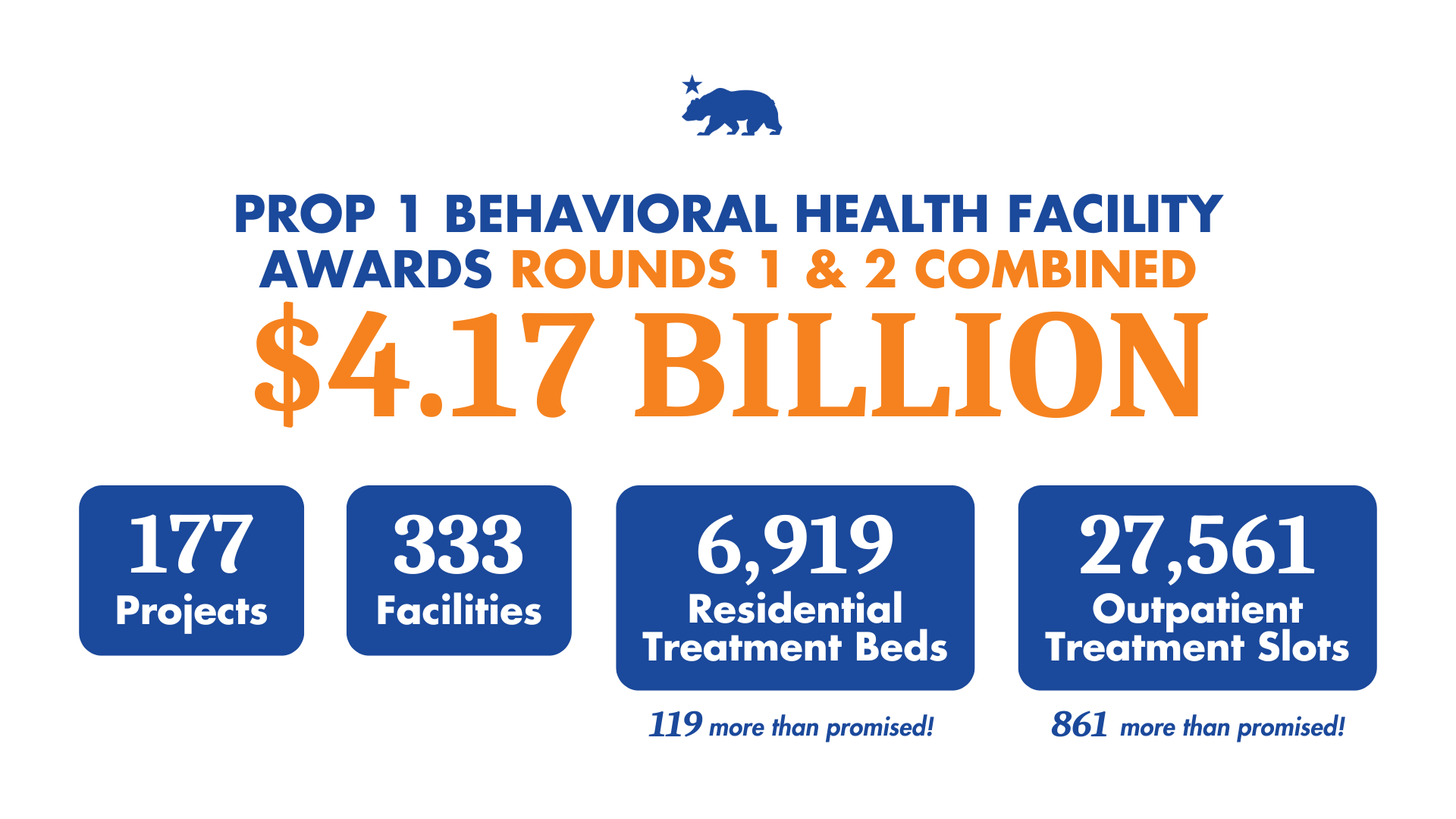
As the final funding round, Bond BHCIP Round 2, represents California’s continued commitment to responsibly investing public dollars to strengthen the state’s behavioral health system. This round adds 2,554 new residential/inpatient beds and 4,273 outpatient treatment slots.
Combined with Round 1, Bond BHCIP has supported 177 projects across 333 facilities, significantly expanding access to mental health and substance use disorder (SUD) treatment statewide.
“In just two years, California has fully allocated our behavioral health bond and exceeded statewide capacity goals, building treatment access closer to home in the communities with the greatest unmet needs,” said DHCS Director Michelle Baass. “From urgent care and crisis stabilization to residential treatment and peer respite, these projects at hundreds of facilities establish capacity so families in rural, Tribal, and underserved areas can count on consistent, high‑quality care for the next three decades.”
Helping more than 5 million Californians
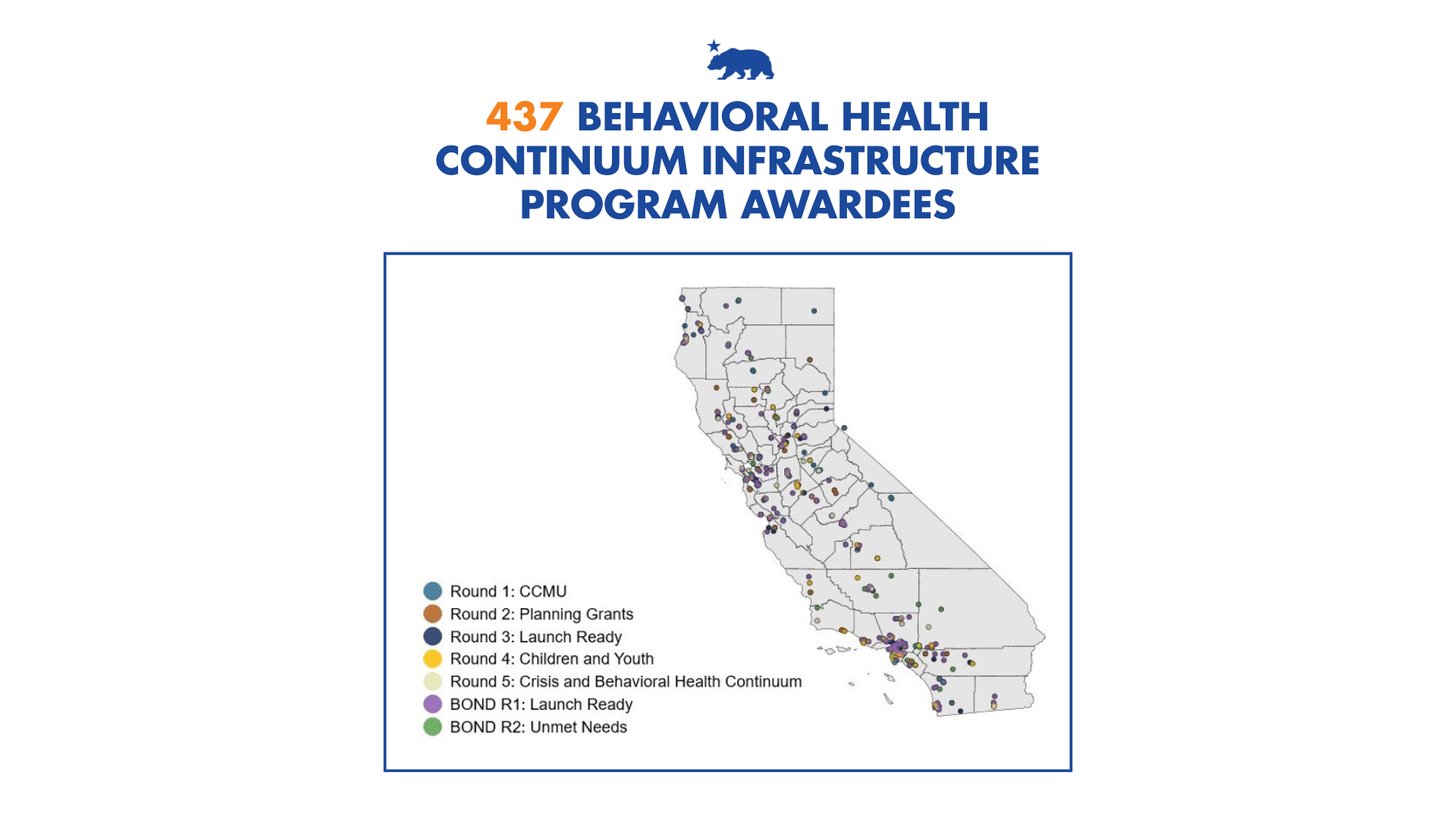
Bond BHCIP builds upon the foundation of the earlier BHCIP initiative, which was funded by the state budget prior to Prop 1. Since 2021, BHCIP has awarded a total of $5.8 billion to expand behavioral health infrastructure. This has resulted in 437 projects across 546 behavioral health facilities, which will create 9,553 new beds and 47,163 new outpatient slots projected to serve more than 5.4 million individuals annually. Together, these efforts strengthen the state’s long‑term community‑based behavioral health infrastructure.
Helping rural and tribal communities
Round 2 includes several first-in-the-state and community-driven models to help:
-
Support tribal communities – $12 million to establish California’s first Tribal Peer Respite (Yurok Tribe), offering peer‑led, community‑based support during behavioral health crises.
-
Address substance use disorders – $4.4 million to create the first residential substance use disorder treatment facility in Glenn County.
-
Serve families and end cycles of abuse – $27 million to establish a new residential SUD treatment program serving fathers with children in the San Joaquin Valley
-
Expand behavioral health treatment – $59 million and $76.8 million ($135.8 million total) for a multicomponent expansion at the St. Vincent Behavioral Health Campus in Los Angeles, which leverages complementary state investments, Behavioral Health Bridge Housing, and Homekey+ to build a more complete continuum of care.
-
Improve criminal justice reentry outcomes – $24 million for a 105-bed SUD treatment center in Ontario, supporting San Bernardino and Riverside counties and focusing on justice-involved men through the provision of reentry services.
-
Provide care – $38 million for SJ BeWell Campus Phase 2 (San Joaquin County Behavioral Health Services) for a 52 bed social rehabilitation facility supporting six total counties in the Northern San Joaquin Valley and builds on a Round 1 award of $137.5 million for a new behavioral health campus with over 130 beds for various programs and over 1,200 annual slots for non-residential treatment programs.
This round also awarded eight projects in small counties, many of which hadn’t previously received an award, including Del Norte ($44.8 million), Inyo ($11.6 million), Shasta ($24.7 million), Siskiyou ($23.7 million), Sutter ($6.6 million), Trinity ($3.5 million), and Yuba ($9.7 million) counties.
Bond BHCIP Round 2 directs resources to the communities that need them most, including tribal partners, awarding six projects a total of $69.6 million in funding. These grants represent a powerful step toward expanding and enhancing behavioral health infrastructure in tribal communities statewide, helping ensure that care is accessible, culturally responsive, and tailored to meet community needs.
Building a stronger mental health system
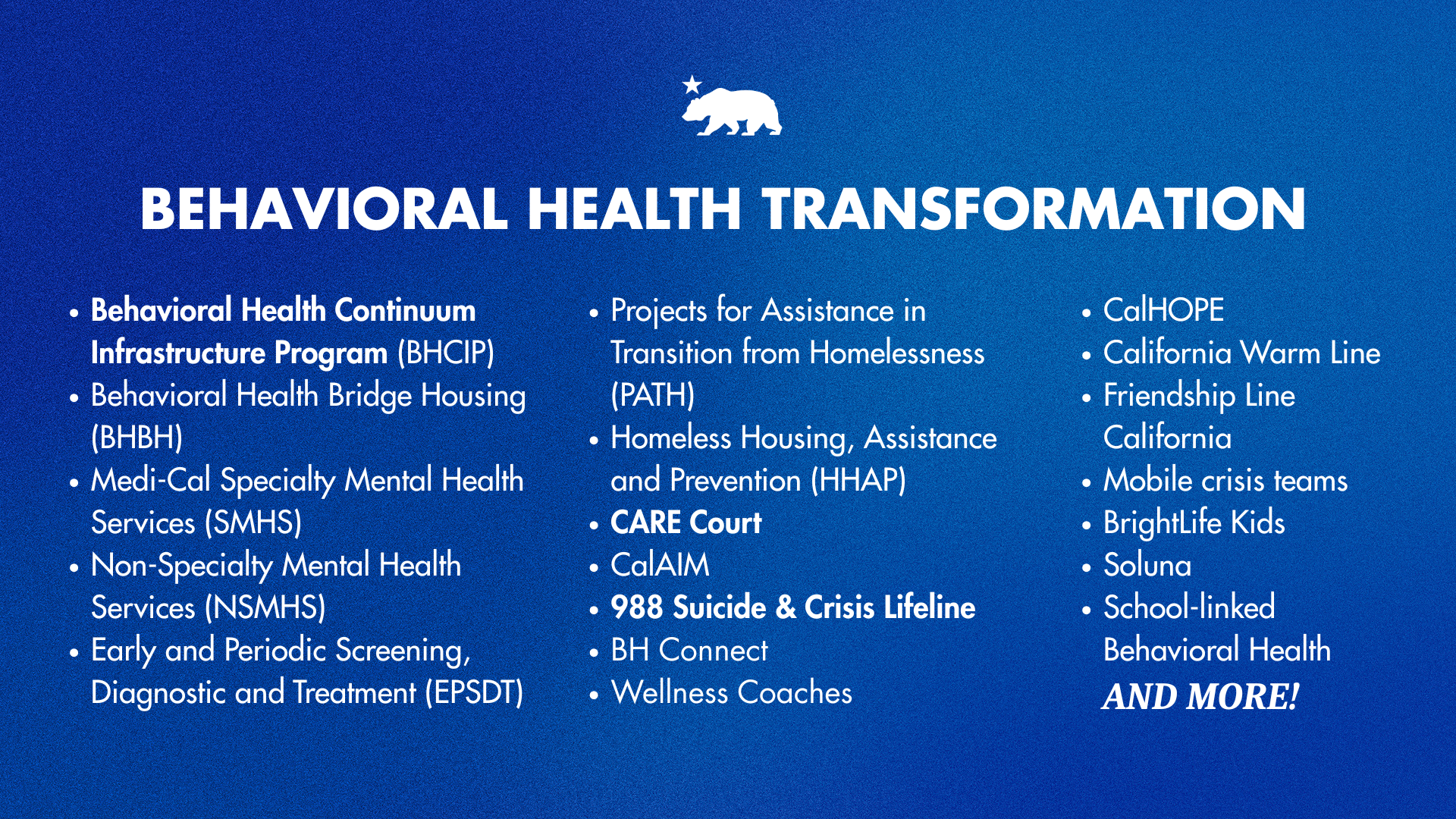
Proposition 1 and BHCIP fit within a broader behavioral health strategy, Mental Health for All, which represents California’s continued commitment to responsibly investing public dollars to strengthen the state’s behavioral health system. Launched under Governor Gavin Newsom’s leadership, this bold initiative is building a stronger, more equitable, and more accountable behavioral health system for Californians across their lifespans.
From addressing the crisis of loneliness in young men through the state’s Path and Purpose Initiative, strengthening tools like the 988 suicide hotline, expanding community mental health supports, building stronger prevention strategies, improving reentry through more robust reentry strategies, building more housing and support, creating stronger trauma and crisis response for children, investing in California’s behaviorlal health workforce and establishing a first-in-the nation CARE Court process to help severally mentally ill people treatment, Governor Newsom is repairing a broken system that has suffered from decades of neglect.
This neglect began under then-Governor Reagan’s administration, when state hospitals were closed, and no adequate alternative was provided, leaving people most in need of help to fall into the criminal justice system or homelessness. This created a generational impact.
Today, across California, individuals with untreated psychosis are 10 times more likely to experience homelessness and 16 times more likely to be incarcerated. Through the many programs and strategies of California’s strong behavioral health continuum, the state is turning this crisis around.
More accountability
Californians can track how their community is addressing mental health, homelessness, and housing at accountability.ca.gov, which was recently updated to include new information on CARE Act implementation by county.
A focus on prevention
California is advancing a comprehensive approach that pairs expanded treatment capacity with stronger statewide prevention efforts. While DHCS is investing billions through BHCIP to expand crisis, residential, and outpatient care, the California Department of Public Health’s newly released Population-Based Prevention Plan focuses on stopping crises before they begin, reducing suicide, overdose, and behavioral health risks through statewide prevention strategies, public awareness campaigns, community partnerships, and culturally responsive outreach. Together, these efforts reflect California’s broader strategy to build a full continuum of behavioral health care that promotes well-being, strengthens communities, and ensures Californians can access support at every stage, from prevention to treatment and recovery.
Reversing decades of inaction on homelessness
Repairing California’s mental health system is a key component in ensuring that the state gets people off the street and into care. Governor Newsom is creating a structural and foundational model for America:
✅ Creating shelter and support — Providing funding and programs for local governments, coupled with strong accountability measures to ensure that each local government is doing its share to build housing, and create shelter and support, so that people living in encampments have a safe place to go.
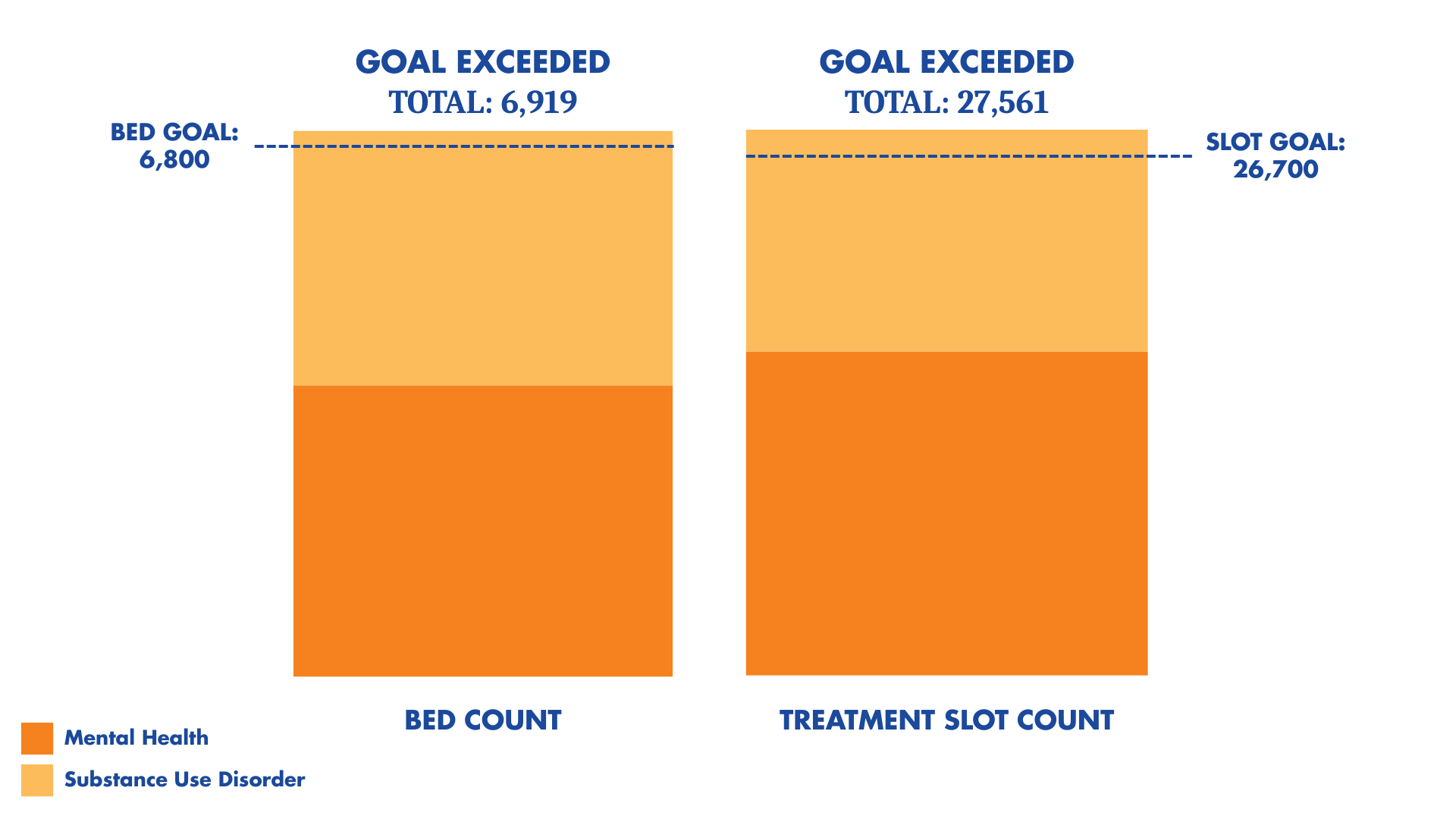
✅ Addressing mental health and its impact on homelessness — Ending a long-standing behavioral health bed shortfall in California by rapidly expanding community treatment centers and permanent supportive housing units. In 2024, voters approved Governor Newsom’s Proposition 1 which is transforming California’s behavioral health systems — delivering more than the promised 6,800 residential treatment beds (6,919) and 26,700 outpatient treatment slots (27,561) for behavioral health care.
✅ Creating new pathways for those who need the most help — Updating conservatorship laws for the first time in 50 years to include people who are unable to provide for their personal safety or necessary medical care, in addition to food, clothing, or shelter, due to either severe substance use disorder or serious mental health illness. Creating a new CARE court system that creates court-administered plans for up to 24 months for people struggling with schizophrenia and other psychotic disorders, often with substance use challenges.
✅ Streamlining and prioritizing building of new housing — Governor Newsom made creating more housing a state priority for the first time in history. He has signed into law groundbreaking reforms to break down systemic barriers that have stood in the way of building the housing Californians need, including broad CEQA reforms.
✅ Removing dangerous encampments — Governor Newsom has set a strong expectation for all local governments to address encampments in their communities and help connect people with support. In 2024, Governor Newsom filed an amicus brief with the Supreme Court defending communities’ authority to clear encampments. After the Supreme Court affirmed local authority, Governor Newsom issued an executive order directing state entities and urging local governments to clear encampments and connect people with support, using a state-tested model that helps ensure encampments are addressed humanely and people are given adequate notice and support.
In 2025, just a year after he issued an executive order urging local governments to better address encampments, the Governor announced his State Action for Facilitation on Encampments (SAFE) Task Force to address encampments in California’s ten largest cities. The task force has addressed encampments in San Francisco, Los Angeles, Long Beach, Sacramento, and Fresno — connecting dozens of people with shelter. Since 2021, Caltrans has removed more than 20,600 encampments on state right-of-way, offered services to nearly 62,000 people, and collected approximately 3.4 million cubic yards of litter and debris.
Legal Disclaimer:
EIN Presswire provides this news content "as is" without warranty of any kind. We do not accept any responsibility or liability for the accuracy, content, images, videos, licenses, completeness, legality, or reliability of the information contained in this article. If you have any complaints or copyright issues related to this article, kindly contact the author above.
